
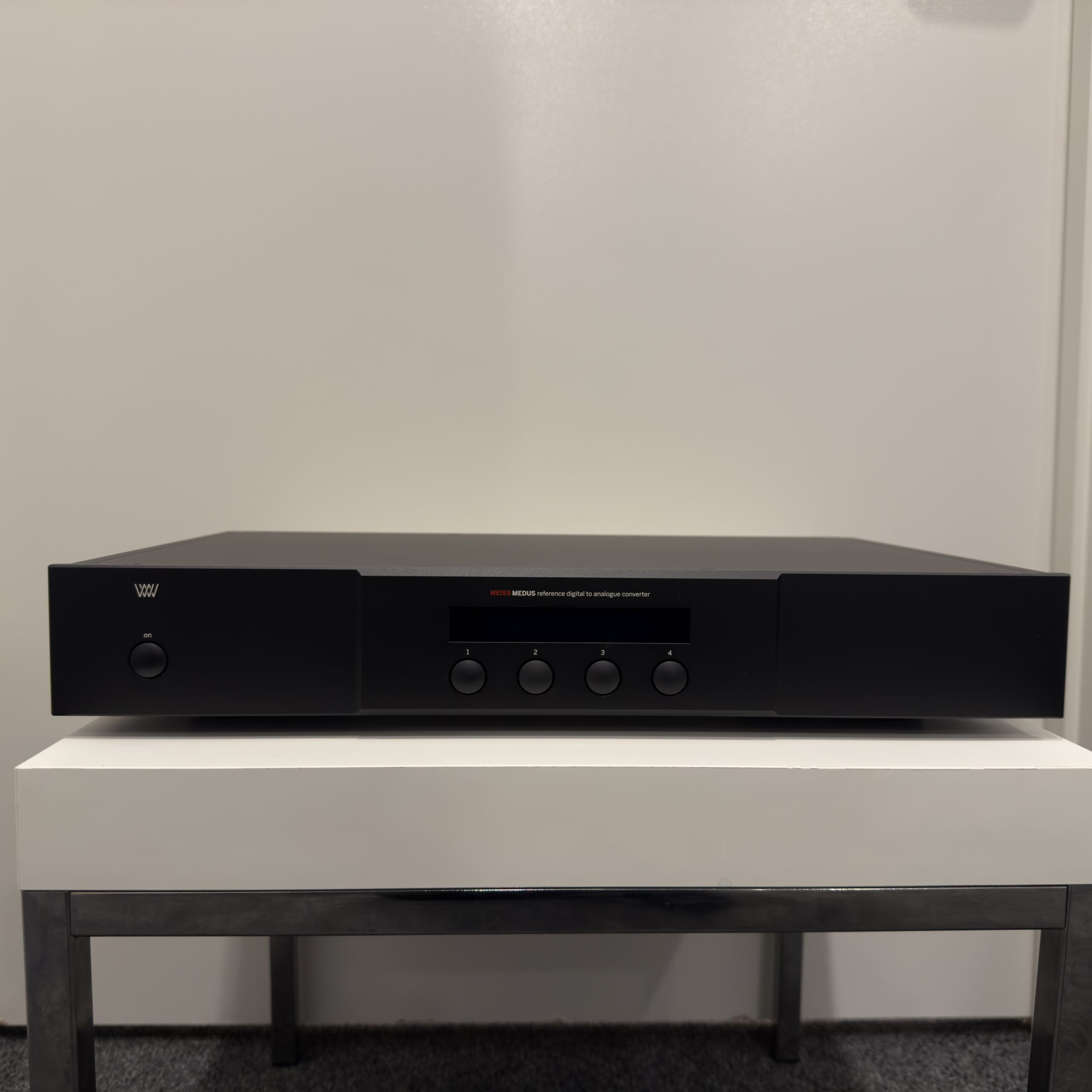
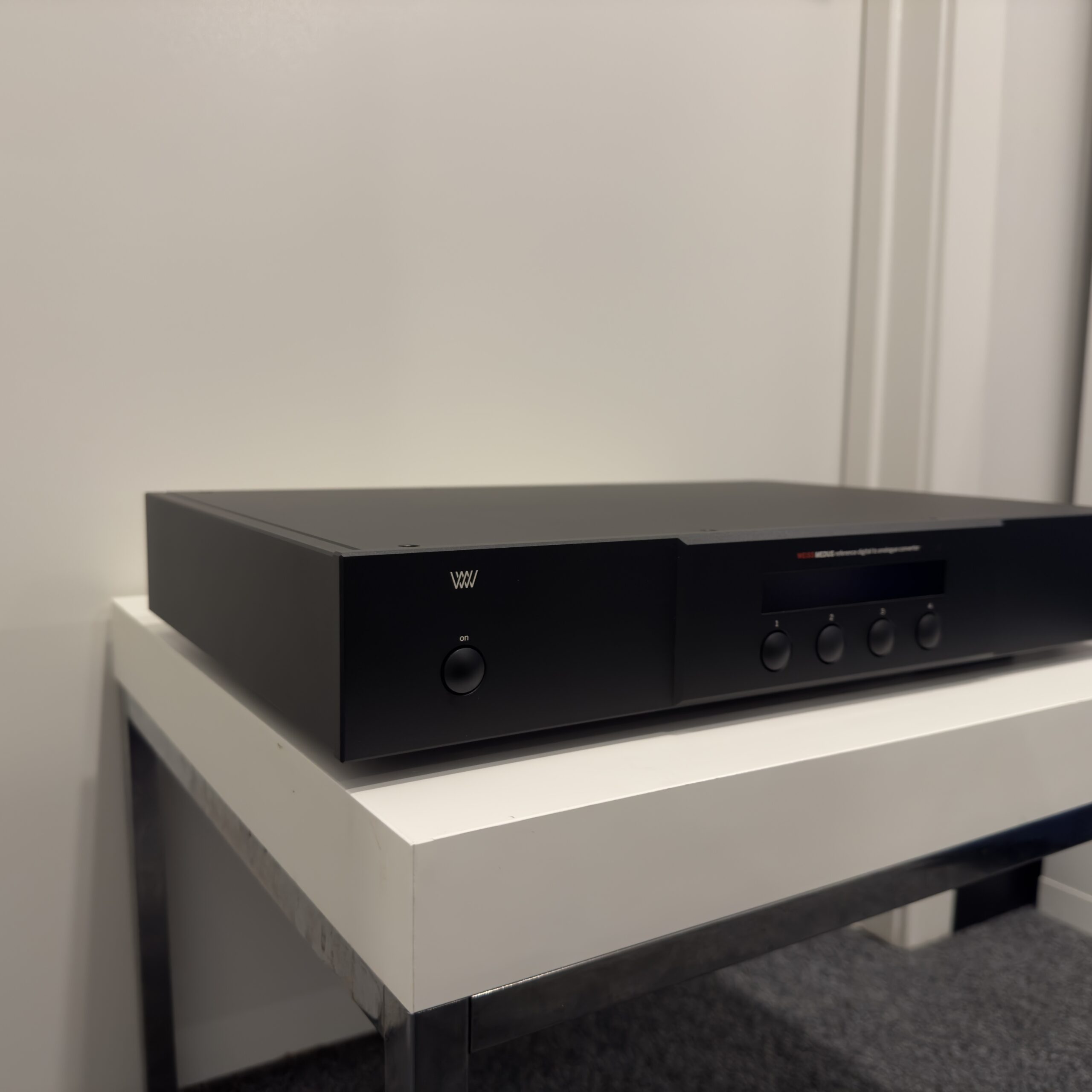
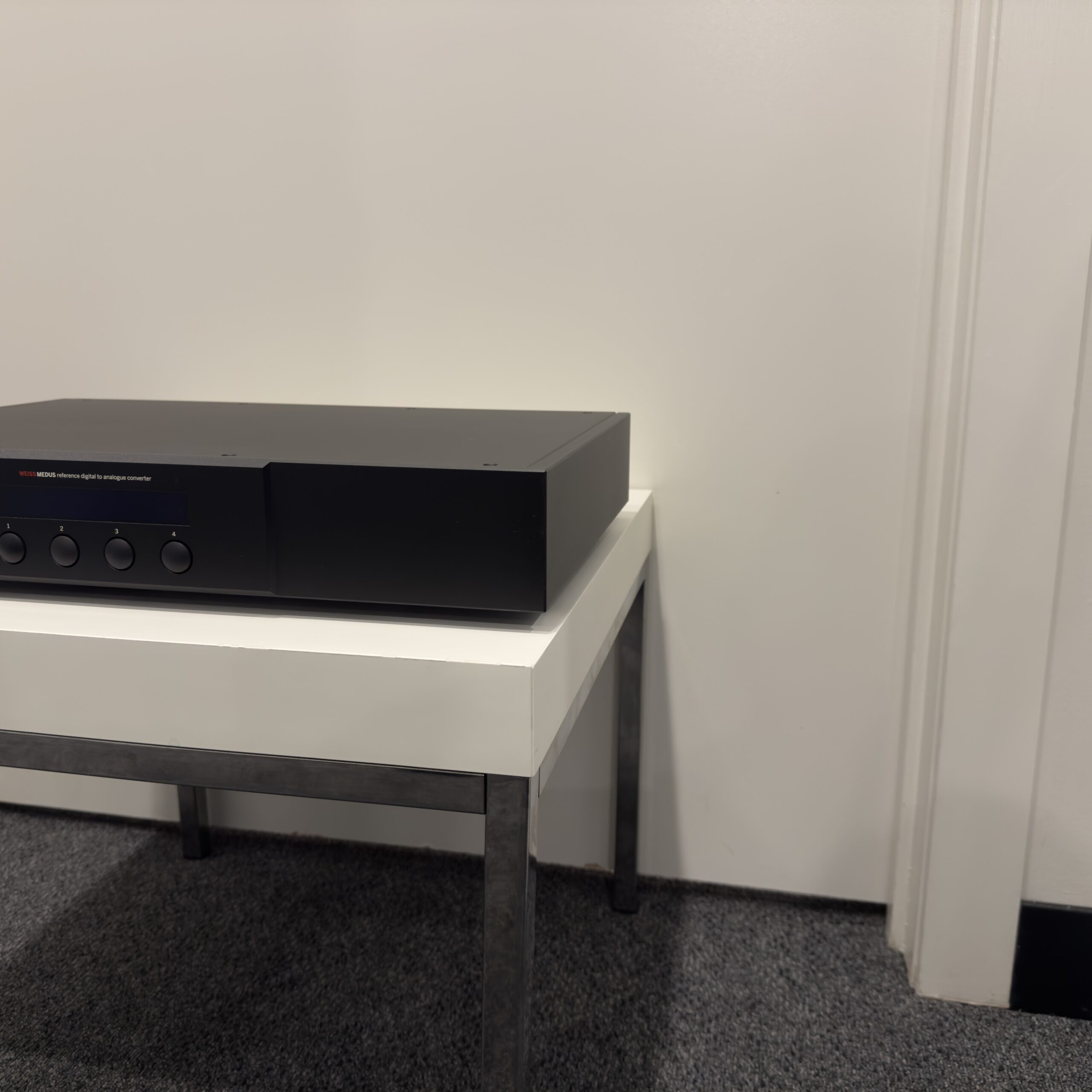
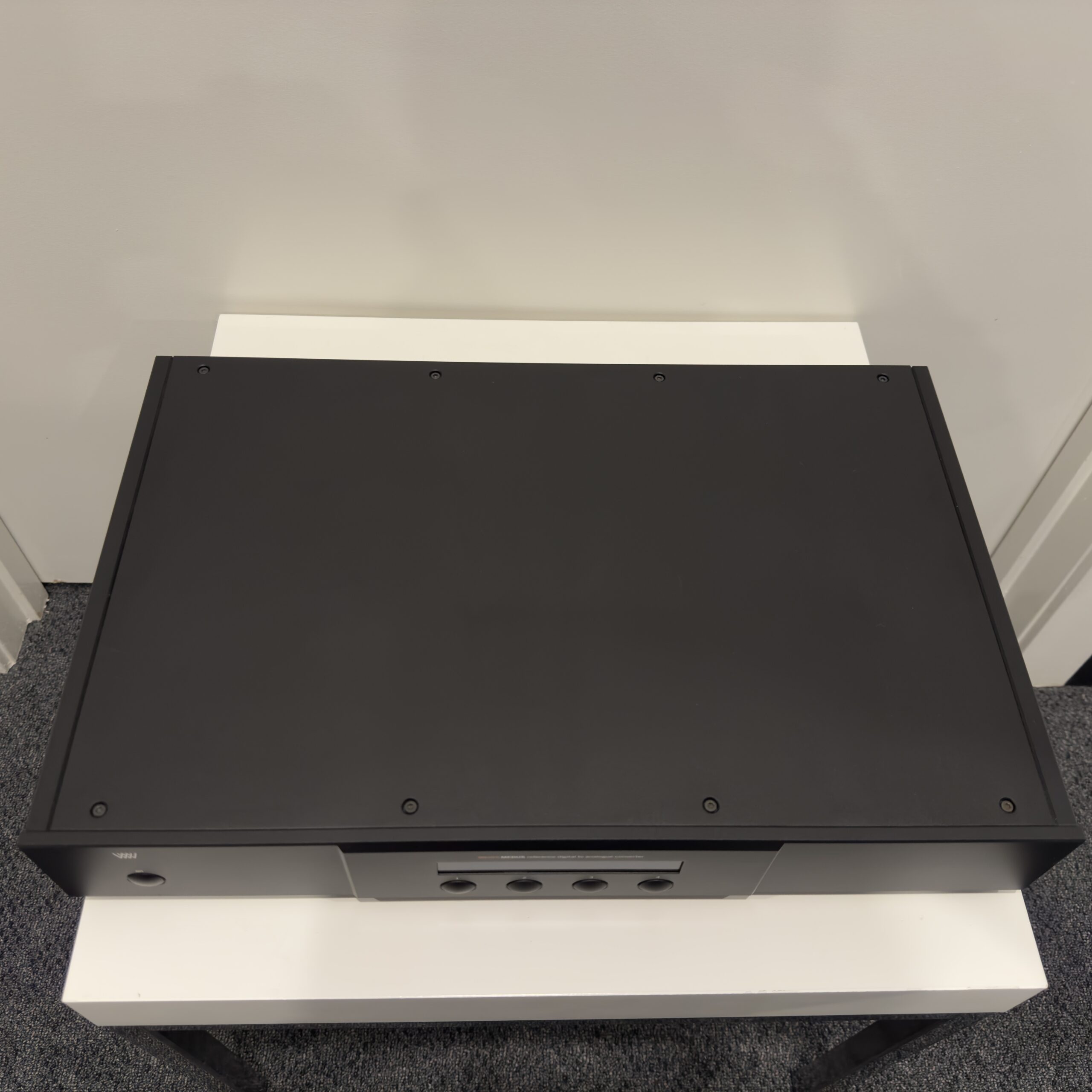
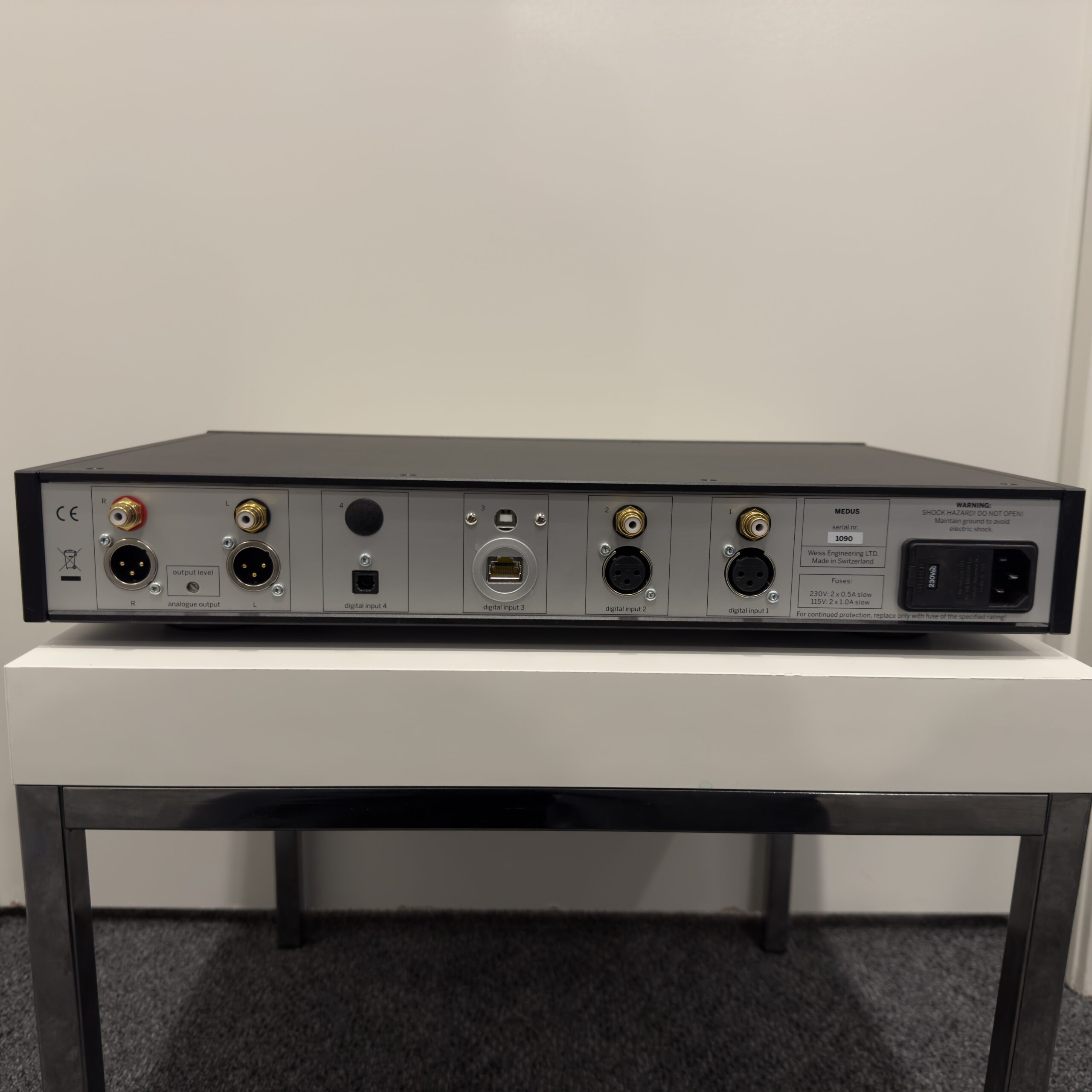
WEISS MEDUS DAC – CONSIGNMENT
Condition: Very good.
Includes: No box, has remote.
Finish: Black.
Note: No original box, but can be carefully packed for delivery.
Overview
Originating in Weiss Engineering’s product line for professional mastering studios, the MEDUS is truly a zero-compromise DAC. For those seeking the same representation of their music as mastering engineers hear when fine-tuning the audio in the studio, the MEDUS is the unit to get.
Professional level at home
Weiss Engineering’s professional clients work in the world’s top-tier studios, fine-tuning the sound of the biggest artists on the planet. It is not an option for them to use anything but the best monitoring chains in existence. This is why they use Weiss Engineering’s professional DACs.
The MEDUS maintains that same quality level, with design and features that better suit the high-end hi-fi market. With the MEDUS, you are hearing what the professionals are hearing.
FOUR DIGITAL INPUTS
The MEDUS has four digital stereo inputs, allowing up to four different input sources to be connected. The user can easily switch between the input sources from the front panel or by using the MEDUS wireless remote control.
All the digital inputs are AES/EBU. The three first use XLR or RCA connectors, while the fourth uses TOSLINK or RCA connectors. The unit can be custom equipped with USB, Ethernet, Firewire, or ST type glass fiber connectors upon request.
Upsampling and Conversion
Signals at 44.1 or 48 kHz sampling frequency are up-sampled in the MEDUS’ DSP chip, using Weiss’ own up-sampling algorithms.
The 32 Bit DAC chip up-samples the input signal to about 1.5 MHz. Four D/A conversion channels are used per audio channel, resulting in exceptional performance specifications.
Analog Perfection
All analog processing is done with our own discrete operational amplifier modules, the Weiss OP2-BP — arguably the best audio operational amplifier currently available.
Four OP2-BP are used per channel, two for current to voltage (I/V) conversion and two for the balanced and unbalanced output stages. The OP2-BPs run in class A mode for all common loads.
Synchronization
The MEDUS is synchronized by the input signal present at the selected input. Several signal re-clocking schemes are combined for extremely high jitter attenuation down to subsonic frequencies, making the MEDUS virtually immune to jitter.
With the USB, Ethernet or Firewire inputs the master clock is generated by the MEDUS.
Power Supply
A powerful non-switching power supply is used. All sensitive voltages have their own regulators which are separated between left and right channels. The result is an analog output free of “digital noise” and channel crosstalk.
The power switch activates a semiconductor relay which only switches on or off at zero crossings of the mains voltage. This assures a glitch-free power switching. The mains transformer sits in a mu-metal shielding box.
Specifications
- (3) XLR connectors
- (1) TOSLINK connector (optical)
- (4) RCA connectors
- All inputs accept professional or consumer standard, i.e. accept AES/EBU or S/PDIF signals
- Sampling frequencies; single wire scheme: 44.1kHz, 48 kHz, 88.2 kHz, 96 kHz, 176.4 kHz or 192 kHz on any of the four inputs
- Sampling frequencies; dual wire scheme: 88.2 kHz, 96 kHz, 176.4 kHz or 192 kHz on inputs 1 and 2
- Sampling frequencies of 352.8kHz or 384kHz: On USB input
- DSD64, DSD128: On USB input
- Sampling frequency tolerance: ±80 ppm
- Maximum input word-length: 24 Bits
- (2) XLR Connectors
- (2) RCA Connectors
- Servo-less, DC coupled, short circuit proof output circuitry
- Output impedance: < 100 Ω
- Output level: variable from −4.0 dBu to +27.0 dBu balanced on XLR connectors (−10.0 dBu to +21.0 dBu unbalanced on RCA connectors) with 0 dBFS input, in 1 dB steps (−4 dBu is 0.49 V, +27 dBu is 17.35 V, −10 dBu is 0.245 V, +21 dBu is 8.67 V)
- Output stage: Discrete Class A
- Fs = 44.1 kHz: 0 Hz-20 kHz: within ±0.25 dB
- Fs = 48 kHz: 0 Hz-20 kHz: within ±0.25 dB
- Fs = 88.2 kHz: 0 Hz-30 kHz: within ±0.75 dB
- Fs = 96 kHz: 0 Hz-30 kHz: within ±0.75 dB
- Fs = 176.4 kHz: 0 Hz-40 kHz: within ±0.75 dB
- Fs = 192 kHz: 0 Hz-40 kHz: within ±0.75 dB
Signal To Noise Ratio (SNR) at −40 dBFS input:
- > 129 dB un-weighted
(relative to full-scale output) - > 132 dB A-weighted
(relative to full-scale output)
- < −112 dB @ −3 dBFS input
(0 dBFS = +27.0 dBu) - < −115 dB @ 0 dBFS input
(0 dBFS = +27.0 dBu)
MEDUS
Depth: 30 cm / 11.8 inches
Width: 45 cm / 17.7 inches
Height: 6.6 cm / 2.6 inches
Height with feet: 7.4 cm / 2.9 inches
IR Remote Control
Depth: 2.5 cm / 1 inch
Width: 6.2 cm / 2.44 inches
Height: 16.9 cm / 6.65 inches
A powerful non-switching power supply is used. All sensitive voltages have their own regulators which are separated between left and right channels. The result is an analog output free of “digital noise” and channel crosstalk.
The power switch activates a semiconductor relay which only switches on or off at zero crossings of the mains voltage. This assures a glitch-free power switching. The two mains transformers are toroidal types.
Mains voltage selection is done automatically by measuring the mains voltage before power is applied to the rest of the electronics.